
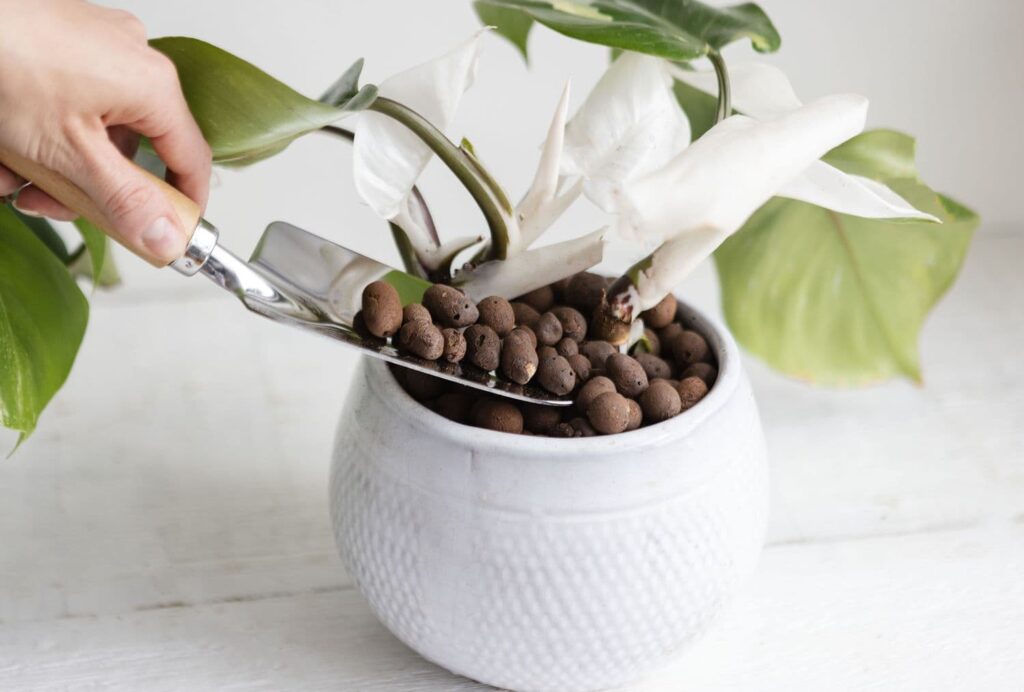
Self watering planters are designed to simplify plant care, but many indoor gardeners wonder if they can use LECA (Lightweight Expanded Clay Aggregate) instead of traditional soil. The short answer is yes — LECA can work in self watering planters, but there are a few important things to understand before switching your growing medium.
LECA is popular in semi-hydroponic growing systems because it retains moisture while still allowing plenty of airflow around plant roots. In the right setup, this can make it a good match for certain types of self watering planters.
If you’re new to these containers, it may also help to understand how the reservoir system functions. Our guide on How Do Self Watering Planters Work explains the basic mechanics behind water reservoirs and wicking systems.
How LECA Works in Self Watering Planters
LECA consists of small clay balls that absorb water and slowly release it to plant roots. In a self watering planter, water stored in the bottom reservoir moves upward through a wick or through direct contact with the LECA.
Instead of soil pulling water upward through capillary action, the LECA balls hold small pockets of water and air. This combination can create a stable moisture environment for plant roots.
However, unlike soil, LECA does not contain nutrients, so plants must receive fertilizer through the water supply.
Benefits of Using LECA Instead of Soil
Many indoor gardeners prefer LECA because it solves several common plant problems.
Better airflow for roots
Clay pellets create gaps that allow oxygen to reach the roots. This reduces the risk of root rot compared with dense soil mixes.
Cleaner indoor gardening
LECA produces very little mess. There is no loose soil to spill when moving your plants around the house.
More consistent watering
Because the clay balls absorb and release water gradually, plants may experience more stable moisture levels.
If you’re still deciding between growing mediums, it’s worth reviewing our guide on Best Soil for Self Watering Planters, which explains when traditional potting mixes may work better.
When LECA Works Best
LECA tends to perform best in self watering systems with plants that tolerate semi-hydroponic conditions. Some popular examples include:
- Pothos
- Philodendron
- Monstera
- Peace lilies
- Snake plants
These plants adapt well to steady moisture and strong root aeration.
Plants that prefer drier soil conditions or that are sensitive to constant moisture may not perform as well in LECA setups.
Potential Drawbacks to Consider
Although LECA has many advantages, it is not always the easiest option for beginners.
Nutrient management
Since LECA contains no organic matter, plants rely entirely on liquid fertilizer.
Initial plant transition
Plants growing in soil need to be carefully cleaned before transferring to LECA. Any remaining soil can lead to rot or fungus issues.
Salt buildup
Over time, fertilizer salts may accumulate on the clay pellets, which means they need occasional rinsing.
For experienced indoor gardeners, these tasks are manageable, but they do require a bit more attention than traditional soil setups.
Final Thoughts
Yes, you can absolutely use LECA in self watering planters, and many indoor gardeners find it a highly effective growing method. The key is understanding that LECA behaves more like a hydroponic medium than traditional soil.
With the right plant choices and proper fertilization, LECA can provide excellent root aeration, stable moisture levels, and a cleaner indoor gardening experience.
FAQ
Can LECA replace soil in self watering planters?
Yes, LECA can replace soil in many self watering planters, especially for plants that thrive in semi-hydroponic environments.
Do plants grow faster in LECA?
Sometimes. When nutrients and moisture are properly balanced, plants can grow quickly because roots receive both oxygen and water efficiently.
Do you need fertilizer when using LECA?
Yes. Because LECA contains no nutrients, plants must receive liquid fertilizer added to the water reservoir.