
Introduction
“Can you overwater plants in a self watering planter?”
This is one of the most common questions people ask before switching to this system — and for good reason.
A built-in reservoir sounds like a promise of constant water. And constant water, in most people’s experience, equals root rot, yellow leaves, and a dead plant.
Here’s the short spoiler before we go any further:
Yes — overwatering is possible. But it doesn’t work the way most people think.
Overwatering in a self watering planter follows different rules, shows up differently, and usually happens much more slowly. In fact, most problems people blame on “too much water” are not caused by the system itself at all.
Understanding how water actually reaches the roots is what removes most of the fear.
Short Answer: Yes — But Not the Way You Think
If you’re looking for the quick version:
- Yes, plants can suffer from excess moisture in a self watering planter
- No, the planter does not automatically flood your plant
- And no, filling the reservoir once does not instantly overwater anything
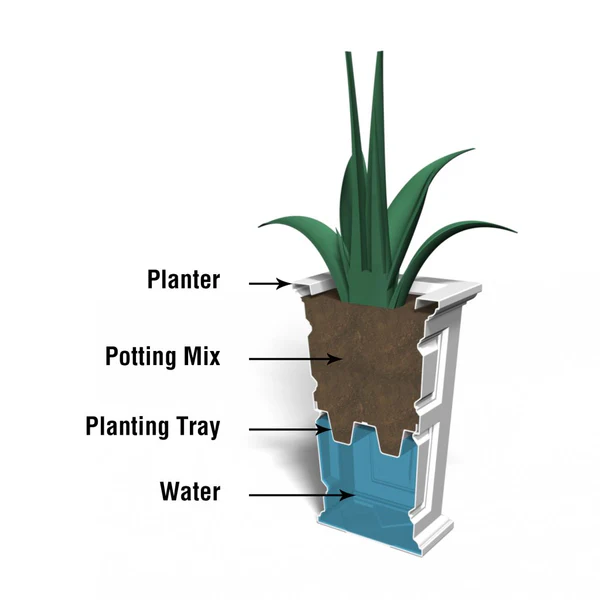
A self watering planter does not push water into the soil.
The plant pulls water upward as it needs it.
Most issues happen only when several factors combine over time — not from one refill, and not overnight.
In other words:
Self watering ≠ automatic overwatering.
How Overwatering Works in Traditional Pots vs Self Watering Planters
This is where most confusion starts.
Traditional Pots
- Water is added from the top
- Soil becomes wet all at once
- Excess water may sit around roots
- Roots can be surrounded by saturated soil very quickly
In this setup, overwatering is fast and easy. One heavy watering can be enough.
Self Watering Planters
- Water sits in a separate reservoir
- Moisture moves upward slowly through capillary action
- Roots interact with moisture gradually
- Soil is not suddenly soaked from top to bottom
Because the mechanism is different, everything else changes too:
- Symptoms appear slower
- Mistakes accumulate gradually
- Most problems are reversible
This is why advice for regular pots often doesn’t apply directly here.
When Overwatering Can Happen in a Self Watering Planter
Acknowledging the risk matters. Overwatering isn’t impossible — it’s just conditional.
🔹 Wrong soil mix
If the soil is:
- too dense
- lacks air pockets
- designed to stay wet
…then moisture doesn’t move or release properly. Roots may sit in heavy, airless soil even if water delivery is slow.
🔹 Reservoir constantly kept full
A reservoir that never empties means:
- no drying phase at all
- less oxygen reaching roots over time
Plants don’t need drought, but many benefit from brief pauses.
🔹 Planter too large for the plant
A small root system + a large water source = imbalance.
The plant simply can’t use water fast enough yet.
🔹 Plants that prefer drying cycles
Not all plants enjoy consistent moisture. Some naturally expect soil to dry out between watering cycles.
The key point here is timing:
Overwatering in self watering planters is slow and cumulative — not sudden.
Signs That Look Like Overwatering (But Often Aren’t)
This is where many people panic unnecessarily.
- Soil is dry on top
→ This is normal. Water comes from below. - The reservoir level doesn’t drop much
→ Young plants and low-light conditions slow water use. - Growth seems slower at first
→ Roots are adjusting to a new moisture pattern. - Leaves feel soft, not crispy
→ Not all softness means rot. Context matters.
Especially during the first few weeks, these signs are often part of adaptation — not a problem.
Real Signs of Overwatering in a Self Watering Setup
Actual overwatering looks more like a pattern, not a single symptom.
Watch for combinations like:
- Soil that stays constantly heavy and wet
- Yellowing lower leaves that don’t recover
- No new growth over an extended period
- A stale or sour smell coming from the soil
One sign alone rarely means much.
Time and repetition matter more than one observation.
Why Most People Think They’re Overwatering (But Aren’t)
This fear is surprisingly psychological.
- The term “self watering” sounds extreme
- There’s no visible top watering, so control feels lost
- Habits from traditional pots don’t translate
- People expect fast, visible results
When nothing dramatic happens, it feels wrong — even when it’s actually working as intended.
Many common concerns come from expectations, not plant signals.
How to Reduce Overwatering Risk (Without Micromanaging)
This system works best when you don’t fight it.
Helpful mindsets:
- Observe trends, not daily changes
- Allow the reservoir to empty occasionally
- Avoid constantly checking or adjusting
- Let the plant grow into the planter size
You’re not trying to control every variable — you’re letting the system do what it was designed to do.
Is Overwatering More Common Indoors?
It can feel more common indoors, yes.
Not because of the planter — but because:
- evaporation is slower
- light levels are lower
- temperatures are stable
All of this slows water usage. The solution isn’t fear — it’s patience and awareness of environment.
Conclusion
So, can you overwater plants in a self watering planter?
Yes.
But it’s:
- uncommon
- slow to develop
- and almost always fixable
Most plants fail not because the system gives too much water — but because people try to control it like a traditional pot.
Understanding how the system works matters more than trying to control it.
That understanding is what turns self watering planters from a source of anxiety into what they’re meant to be: calm, predictable, and forgiving.